Churn management
How to Reduce Subscription Churn: 3 Retention Strategies To Test
Share:
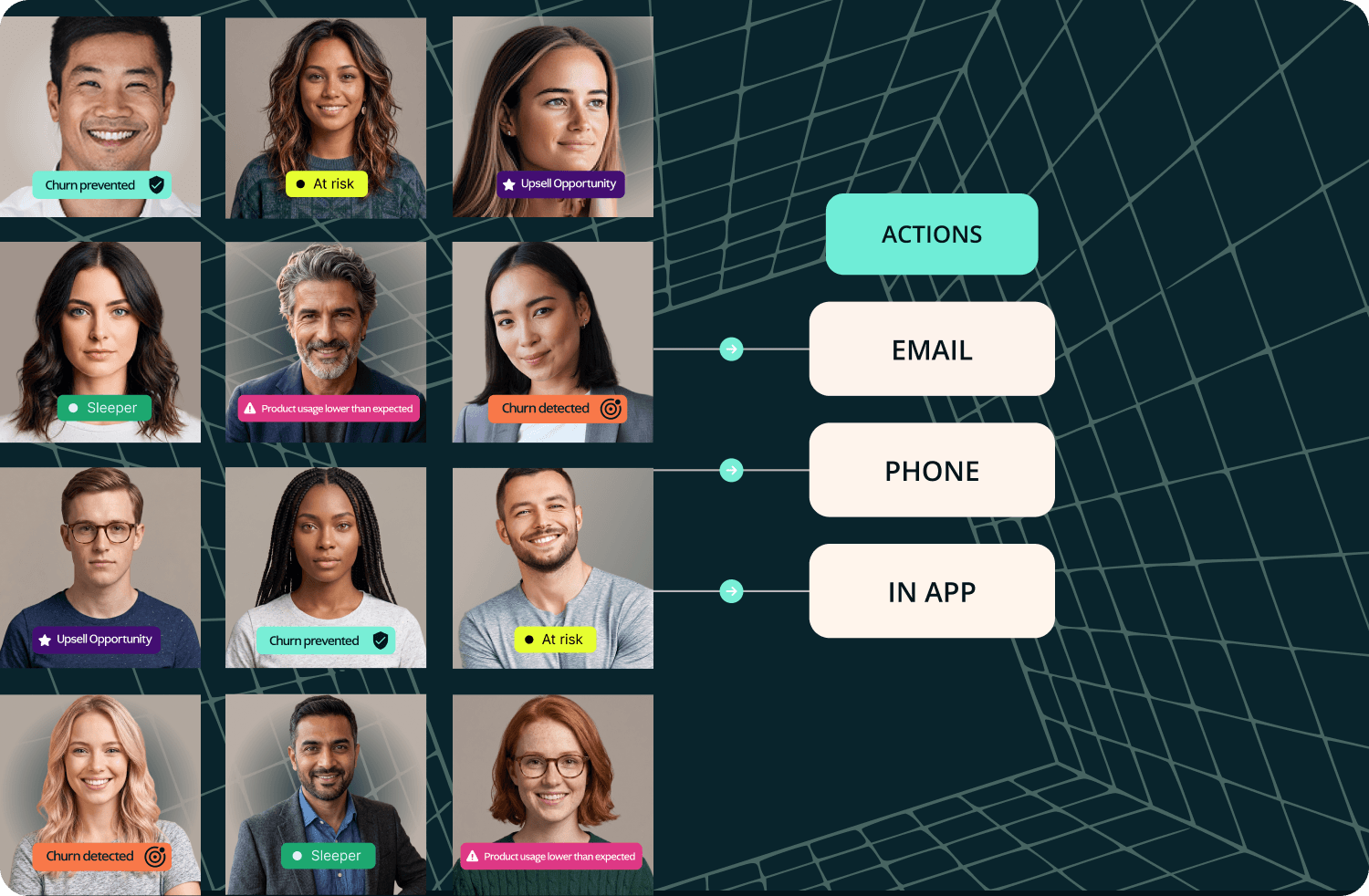
Most retention teams can tell you exactly who cancelled last quarter.
But predicting churn isn't the same as knowing what to do about it right now.
Here’s how to make your retention data into an actionable strategy.
Churn data describes the problem, but it doesn't solve it
Data teams often provide churn rates, health scores and renewal reports. While useful, these "narrative" numbers describe what happened, rather than "diagnostic" numbers that show how to fix it.
These numbers leave out the two things your retention & marketing team actually needs:
Why it happened
What to do about it
Why it happened
A metric like "4.2% of subscribers churned in Q1" doesn't tell much beyond who cancelled.
This lack of context leads to inaccurate predictions and misguided retention strategies. It's a reactive approach, relying only on a static snapshot of one period that doesn't account for seasonal trends, promotional cycles, or your own marketing activity.
Customers who churned after a heavy Black Friday discount are a different problem than customers who churned after a competitor launched a new product. Treating them as one number means treating them as one problem when they aren’t.
What to do about it
A churn score without a next-best-action isn't a retention strategy.
At-risk customers experiencing service issues need a completely different response than those who are price-sensitive. Sending the same save offer to both wastes budget on one and misses the point entirely for the other.
Broad segments don't give you enough to act onHere's a common mistake: a team identifies that "men aged 25-35" churn at a higher rate and builds a retention campaign around it. Going on basic health scores, demographics, or subscription info doesn't tell you why that specific person churned. The signal that actually moves retention sits at the intersection of who someone is and what they're doing. For example:
|
Knowing both is imperative. The "why" shapes the "what to do."
Without understanding the reason behind a subscriber's drift, any action you take is a guess. Churned processes all these behavioral signals at the individual level, so your retention plays can be built around what that specific subscriber actually did.
Focus on what you can control
Company-wide problems like product failures or service gaps may sit entirely outside your scope.
The smarter move is to focus your data and your budget on the levers you can actually pull.
For instance, if the finance team has cut your discount budget, don't spread what's left across your whole subscriber base. Instead, use segmentation to make sure discounts only reach the most at-risk customers or those with a CLTV worth protecting.
Know what the business is willing to change
Price, product, and marketing decisions rarely sit with one team, and save-plays almost always involve departments beyond retention and CRM.
Before building any campaign, you need a clear picture of what is actually possible.
Get to know the stakeholders involved and the influence they have.
Understand what success looks like for each team and how you can quantify that.
In some cases, this could mean churn is inevitable. For example, if a large cohort is churning after your Black Friday promotion but marketing is committed to running it again for competitive reasons, then you may need to accept (and expect) a spike in churn.
Map your constraints before you build
Get specific about what you are actually working with before you start.
How much discount budget is available, and which segments should it go to?
How many free features or trial extensions can you offer?
How much CX collaboration is realistic if the churn is service-related?
How is your CRM set up to run winback flows for subscribers who cancelled over a product issue?
These aren't secondary questions. They determine whether your strategy is executable or just a plan that looks good on paper.
Read more: Implementing AI for Subscription Retention
3 Retention Strategies to Test
Every churn report should be able to answer one question: Based on this data, what's the one specific thing the retention team should do tomorrow?
Strategy 1: Hyper-specific targeting
Most high-volume brands bleed cash trying to save everyone. If a subscriber has a low lifetime value and has ghosted your platform, throwing incentives at them is a bad investment.
Only target segments showing signs of "the drift" that still hold a profitable lifetime value.
Ignore the unengaged, low-value base — trying to rescue them destroys your unit economics.
Solve strictly for CLTV, your budget goes only toward customers worth keeping.
Strategy 2: Try non-monetary offers
Discounting everyone who clicks "cancel" trains your entire subscriber base to never pay full price again. You already own assets that cost nothing to distribute but carry real perceived value.
Offer early access to an upcoming feature or content drop.
Trigger an AI-matched feature recommendation for inactive users.
Offer a temporary downgrade instead of a full cancellation.
Strategy 3: Let AI learn and adjust
A perfect offer still fails if it arrives through the wrong channel. Pushing an alert to a disengaged subscriber can backfire entirely, reminding them they are paying for something they no longer use.
Use machine learning to decide not just what offer to send, but how and when, based on each subscriber's engagement history.
Send at the most optimal time, rather than renewal sequences that are time-bound
Route the action through a call, an email, or in-app push notification.
Keep in mind sometimes the best move is staying quiet and sending nothing at all.
Churned triggers these actions directly into your marketing tools and keeps learning from outcomes, so your plays get sharper over time.
The drift is happening right now in your subscriber base.
If your churn insights aren't automatically triggering the right action, for the right subscriber, through the right channel, you're not retaining. You're just reporting.
That's what Churned is built to fix.

Written by
Maarten Doornenbal
Share:
Curious what Churned can do for your business?