Subscription products
Hidden Costs for Subscription Boxes: Why Churn is Your Biggest Expense
Share:
Subscription boxes offer a unique experience.
They thrive on recurring revenue, but maintaining a loyal customer base remains one of the biggest challenges in the industry. Subscribers join for excitement and discovery, but that novelty fades quickly.
If curation feels repetitive, predictable, or misaligned with evolving tastes, engagement drops. Even one or two boxes that feel "off" can make customers question the value of staying subscribed.
This makes retention a key factor in achieving sustainable growth. While acquiring new customers is important, the real profit comes from keeping existing subscribers engaged and satisfied.
Why subscription growth fails without strong retention
The cost of churn goes beyond lost revenue.
It includes the resources spent on marketing, acquisition campaigns, and onboarding new subscribers. High churn forces brands to continually invest in acquiring new customers without ever achieving stable, predictable revenue.
Retention affects revenue in ways that are both obvious and hidden.
The immediate impact is straightforward: when a subscriber churns, you lose their recurring revenue. But you also lose all the money you spent acquiring them in the first place.
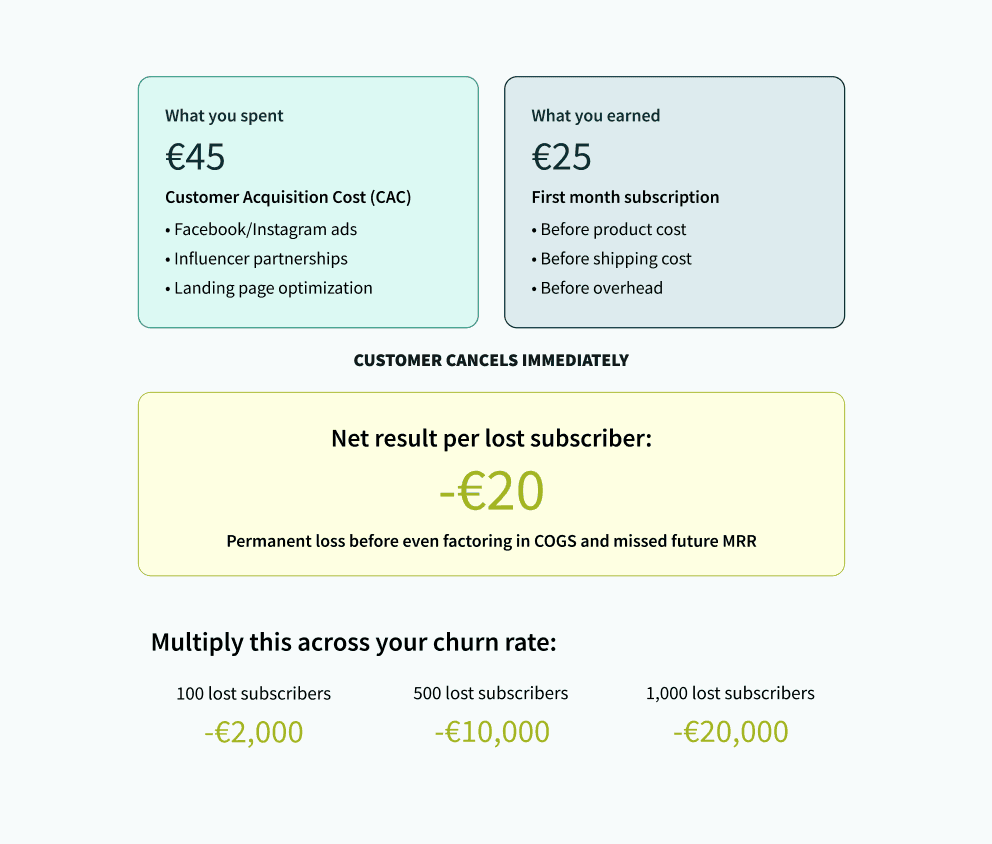
The costs of cancelled subscriptions
If your Customer Acquisition Cost is €45 and a subscriber pays €25 for their first month but cancels immediately, you’ve spent €45 to make €25. That’s a €20 net loss before even factoring in shipping, product, or overhead. Multiply that across hundreds of cancellations, and your business is losing money just to maintain revenue.
Lost Revenue and Wasted Acquisition Spend
The most immediate cost of churn is the loss of predictable recurring revenue. Replacing churned customers means re-engaging in the expensive and time-consuming process of customer acquisition (CAC). With high churn, the revenue gained from new customers may only cover the cost of acquiring them, leaving little room for profit or reinvestment.
Financial Stability through Predictable Recurring Revenue
Businesses that rely heavily on subscription models depend on a steady stream of recurring revenue for long-term financial stability and growth. High retention rates are essential because they ensure a more predictable revenue base, making it easier to forecast future earnings and invest confidently.
Operational Efficiency and Resource Drain
When churn is high, internal teams spend excessive time on reactive "firefighting" efforts, such as responding to cancellation requests or offering last-ditch discounts. This constant, high-touch manual process is resource-intensive, diverting focus from essential tasks like content creation or product innovation.
Brand Reputation Damage
A high churn rate sends a clear signal to the market that your service may not be delivering on its promises. This can harm your brand's reputation and lead to negative word of mouth on social media and review platforms. This damage makes it harder to attract new customers and is often difficult to repair.
Understanding your retention options
Remember, retention isn’t just about subscribers hitting cancel. It encompasses every stage of the customer relationship and every opportunity to deepen engagement. Understanding these different types helps you build strategies that address the full spectrum of consumer behavior, not just the moment a subscriber decides to cancel.
Churn prevention
Churn prevention is the first line of defense. It involves identifying subscribers at risk of cancelling and proactively addressing the friction points. For example, a fitness supplement box may notice a subscriber consistently skipping deliveries. Offering a temporary pause or adjusting delivery frequency can prevent cancellations and maintain the relationship.
Reactivation
Reactivation focuses on winning back lapsed subscribers. Not every cancellation is permanent. Brands can use data to target disengaged customers with personalized offers or curated product recommendations. A pet toy subscription company found that sending a “welcome back” box with new seasonal items successfully reactivated 20% of former subscribers within three months.
Renewals
Renewals increase repeat subscription rates. Retention here is about creating habits and anticipation. By providing a consistent and engaging experience, subscribers are more likely to commit to additional months or annual plans. A meal kit brand achieved a 30% higher renewal rate after introducing customizable menus and flexible scheduling.
Upsells
Upsells boost lifetime value by offering add-ons or higher-tier plans. For example, a monthly coffee subscription can introduce a premium roast option or seasonal sampler packs. Upsells turn existing subscribers into higher-value customers while deepening engagement with the brand.
By breaking retention into these categories, you can focus on specific tactics, measure impact, and continuously improve. Each type requires understanding customer behavior, identifying moments of friction, and creating interventions that feel seamless rather than forced.
Better retention starts with better insights
Stopping churn is the most effective way to stabilize your recurring revenue. By identifying friction points and proactively engaging with your community, you can turn a one-time purchase into a long-term habit that benefits both the subscriber and the business.

Written by
Jessica Rangel
Share:
Curious what Churned can do for your business?