Publishers
BFCM Streaming Retention: How to turn Black Friday Sign-Ups into Subscribers
Share:
Every major streaming service got a lift in subscribers during Black Friday 2025. That includes the ones that didn't run a deal.
Insights from Antenna found that:
Premium SVOD sign-ups jumped 2.8x above their 2025 daily average during Black Friday week
Services running Black Friday offers averaged a 3.1x lift
Those without an offer still averaged 2.2x
That tells us something useful: Black Friday isn't just a promotion.
It's the week a huge number of people decide to try something new, and they shop across every service at once. This makes winning the sign-up the easy part, but keeping that subscriber through their first full-price renewal is where the season is actually won or lost.
Here is an overview of subscriber behavior around BFCM and key strategies for improving retention.
Seasonality in streaming: Why Autumn brings in most new subscribers
Streaming services acquire most of their new subscribers during the autumn season.
Antenna estimates that around 40% of the industry's annual sign-ups occur between September and December. In 2025, seven out of eight major streaming services saw their highest subscriber growth during these four months.
A lot is competing for attention in that window: Live sports, summer blockbusters arrive on streaming and new launches get scheduled into the autumn on purpose.
Hallmark+ averages 3.3x its normal monthly sign-ups across November and December
Shudder draws 2.3x its usual volume in October
Then Black Friday stacks limited-time discounts and multi-service bundles on top of it all, with ad-supported plans often front and centre.
Retention performance: How long do Black Friday signups stay subscribers
Here's the part that surprises people: Black Friday subscribers don't churn faster than everyone else.

In fact, in the first months, they actually look better. According to Antenna's 12-month track of Premium SVOD promotional cohorts:
Month 1 Retention: Black Friday cohorts held strong at 90% (2023) and 91% (2024), significantly outperforming the 76% overall benchmark.
Long-Term Performance: The 2024 Black Friday cohort maintained a +10 point lead over the benchmark through Month 10.
Then the gap closes.
Month 12 Convergence: By Month 12, Black Friday cohorts settled at 37%, running nearly parallel to the overall benchmark and other promotions (36%).
The lesson for retention teams is that Black Friday doesn't buy you more loyal subscribers, it buys you time. Your strategy during this time decides the renewal.
Marketing strategies: Acquire with the renewal in mind
Retention starts with the offer, but the way you acquire a subscriber shapes how likely they are to stay.
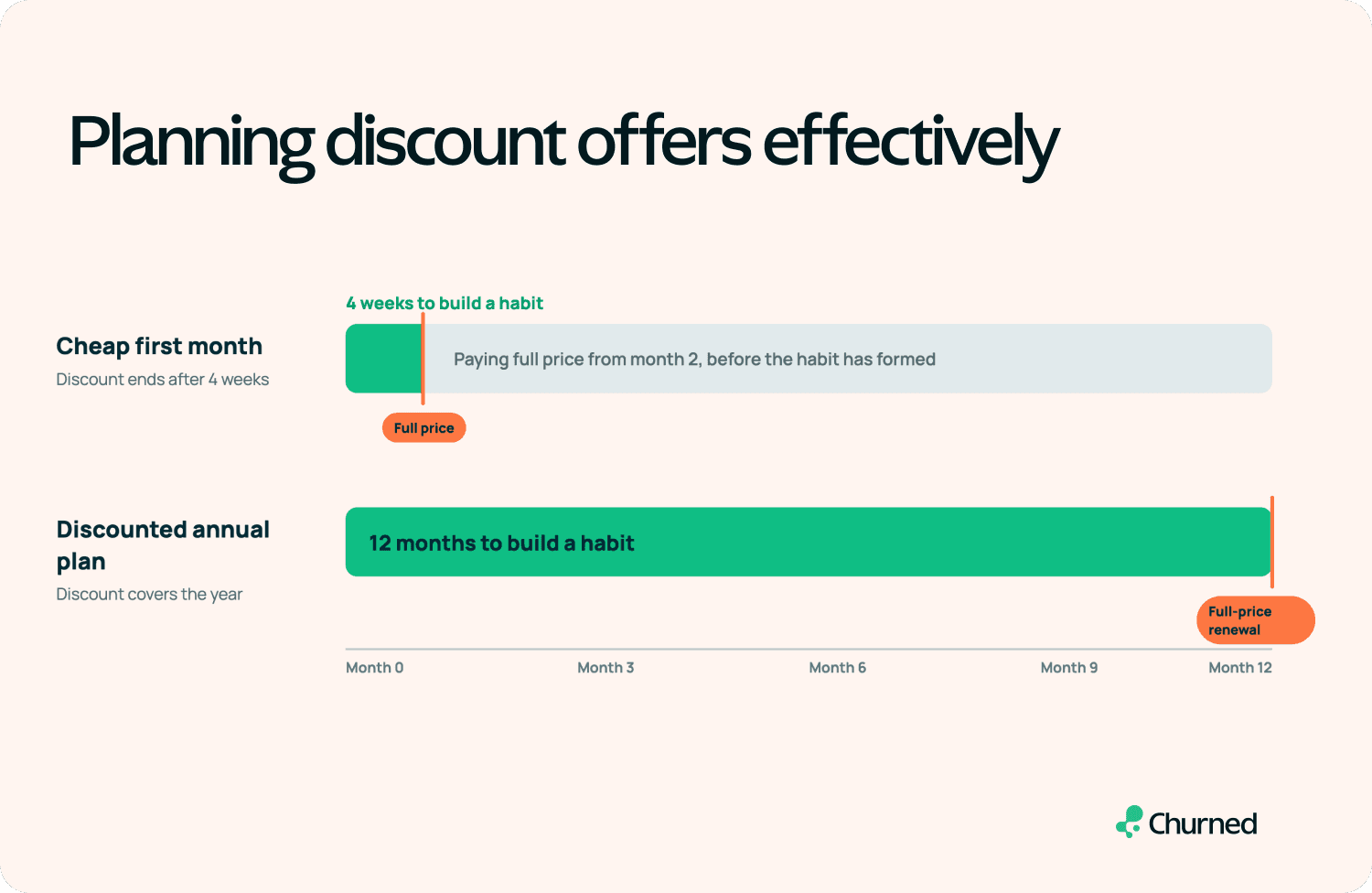
Sell the runway, not just the price
A one-month deal at a low price gives you four weeks to build a habit. A discounted annual or multi-month plan gives you months. If you're going to discount, put the discount where it buys the most time.
Paddle's guidance for subscription apps is a useful benchmark here: cap introductory discounts at around 30 to 40% and focus them on annual plans.
Give ad-tier subscribers somewhere to go
If most of your autumn sign-ups arrive on an ad-supported plan, plan the upgrade path before they join. Don't wait for a calendar date to push it.
Time the upgrade offers a moment of high engagement, such as a binge weekend or the premiere of a big series. That's when the ads feel most annoying and the upgrade feels most worth it.
Lead with the slate, not one title
Campaigns around a single headline series incentivize single-title binge-and-cancel behavior. To improve subscriber LTV, market the upcoming content pipeline across the next 3 to 6 months during sign-up to establish long-term value.
Additionally, ensure your subscription management platform tags every new user by acquisition title and plan type, enabling automated, personalized onboarding and retention flows based on initial intent.
Engagement strategies: Give them a reason to stay
The biggest risk for a Black Friday subscriber isn't the price, it’s keeping their attention.
Plan the next watch before they finish the first
If you know which title brought a subscriber in, you know roughly when they'll finish it.
Recommend the next series while they're still watching the first one, not after the credits roll on the finale. Base it on what they actually watched, not on what's trending across the whole service.
Map your release calendar to your cohorts
Lay your next three to six months of releases next to your Black Friday cohorts. Look for gaps where a cohort has finished its anchor title and has nothing big coming.
Those gaps are where the drift happens. Fill them with library recommendations, a returning favourite, or a new release that matches their taste.
Make light viewers your priority
Heavy viewers will mostly look after themselves. The subscribers to worry about are the ones watching a little, a few minutes here and there.
It’s important to treat this group differently. Build a segment for them and give them your best content nudges first.
Retention strategies: Win the renewal
Engagement buys time, but retention is about securing the renewal before cancelling is even a thought.
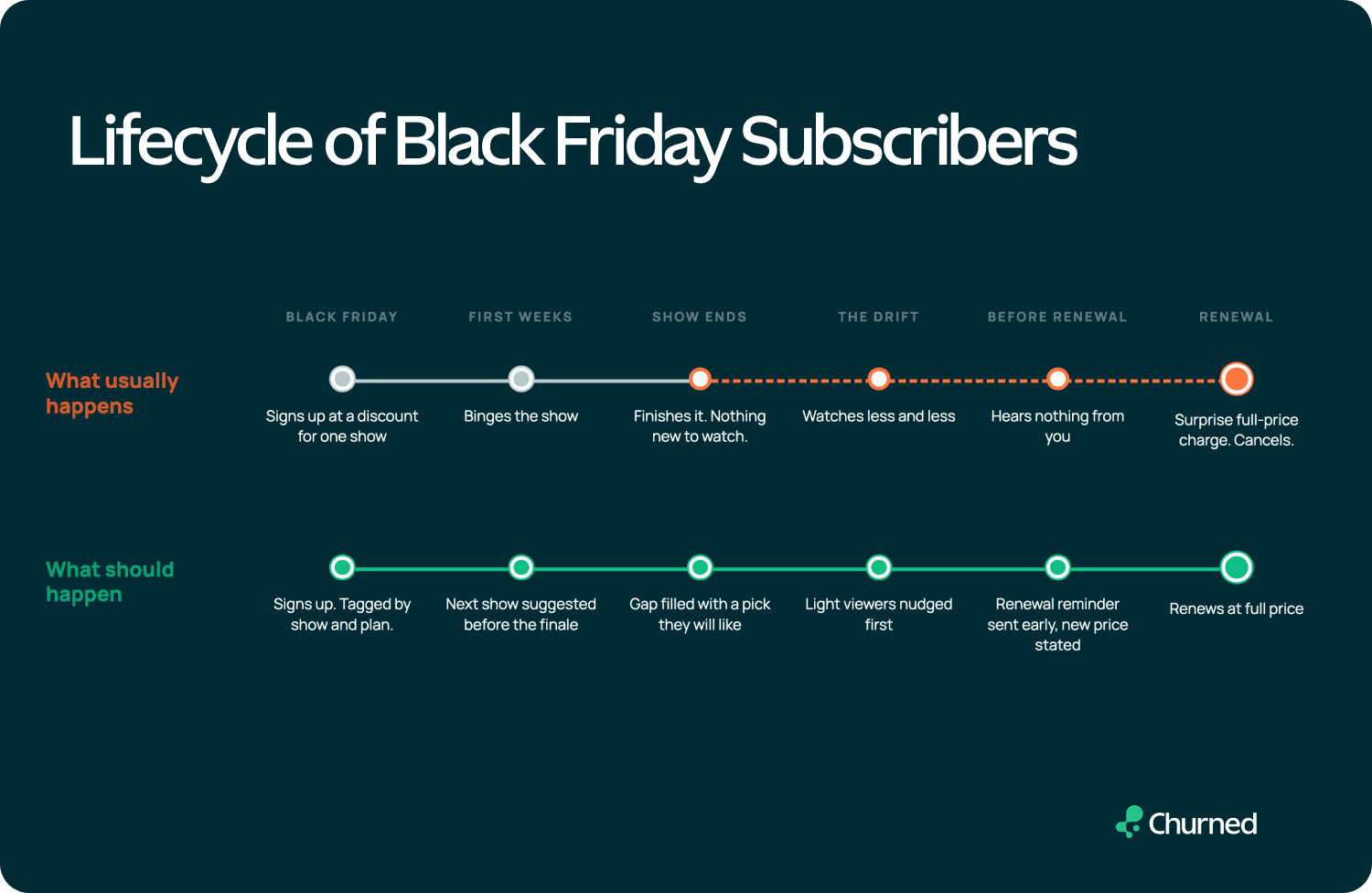
Watch for the “finished watching” signal
"Finished the show they signed up for" is one of the clearest early warning signs in streaming. Pair it with a drop in days active or minutes watched and you have a subscriber in the drift.
Treat that combination as a trigger, not just a line on a report.
Start the renewal conversation early
Don't let the first full-price charge be the first time the subscriber thinks about their plan. A surprise charge is one of the fastest ways to lose someone.
Start a pre-renewal sequence 60 to 90 days out for annual plans, and two to three weeks out for monthly ones.
Remind them what they've watched, what's coming next, and what they get for the price. If you're moving them from a promotional price to full price, say so clearly and early.
Match the action to the subscriber
Not every at-risk subscriber needs the same thing. A light viewer who finished one series might need a strong recommendation. A price-sensitive subscriber might need a downgrade to the ad tier instead of a cancellation. Someone watching every week might need nothing at all.
The work is deciding the next best action for each person, which can be doing nothing. Across hundreds of thousands of subscribers, that's not something a team can do by hand.
Tools like Churned score each subscriber's risk and pick that action automatically, then measure it against a control group, a set of subscribers who get no intervention so you can see the real impact.
Win back with content, not just coupons
Relying solely on discounts to win back lapsed subscribers trains them to wait for price drops rather than valuing your service. Instead, structure your win-back strategy around content momentum to convert former subscribers into loyal, full-value members.
A subscriber who joined for a specific series is far more likely to re-subscribe at full price for the next season's premiere than for a generic 20% discount on a catalog they've already explored.
Capture cancellation reasons, tag subscribers by the specific titles and genres that drove their initial sign-up, and trigger automated re-engagement workflows when relevant new content releases. Leading with compelling content reminders drives higher LTV and protects subscription margin far better than perpetual discounting.
Takeaways
Put your discount where it buys time. Favour annual or multi-month plans over a cheap first month, so you have longer to build a habit before the full-price renewal.
Tag every sign-up by title and plan. You'll need both to predict when the drift starts and what will bring them back.
Map releases against your cohorts. Find the gaps where a cohort has finished its anchor title and has nothing coming, then fill them.
Start the renewal conversation early. Begin 60 to 90 days out for annual plans, and be upfront about the move to full price.
Measure against a holdout. Compare your retention efforts to a group that got nothing, so you know what actually worked.

Written by
Jessica Rangel
Share:
Curious what Churned can do for your business?