AI changes the game by turning engagement signals into actionable intelligence, allowing companies to intervene before cancellations happen. The following use cases demonstrate how AI can be applied to reduce churn, improve lifetime value, and make every subscriber interaction count.
Use Case #1: Predictive Insights
Subscription box brands often struggle with visibility between shipments. The box lands on a doorstep and then a long period of silence follows.
Predictive insights eliminate this blind spot by tracking behavioral patterns across the entire subscriber base.
Most subscribers don’t announce their plan to leave, but their actions provide a clear warning. A skipped survey or a missed unboxing video is often the first sign of trouble. Predictive AI models analyze email open rates and product ratings and payment history to build a real-time health score for every individual.
This score highlights disengagement before a subscriber actually cancels. This is a major upgrade from traditional retention strategies that rely only on historical data. Now these silent signals provide an opportunity for proactive intervention.
Use Case #2: Churn Prevention
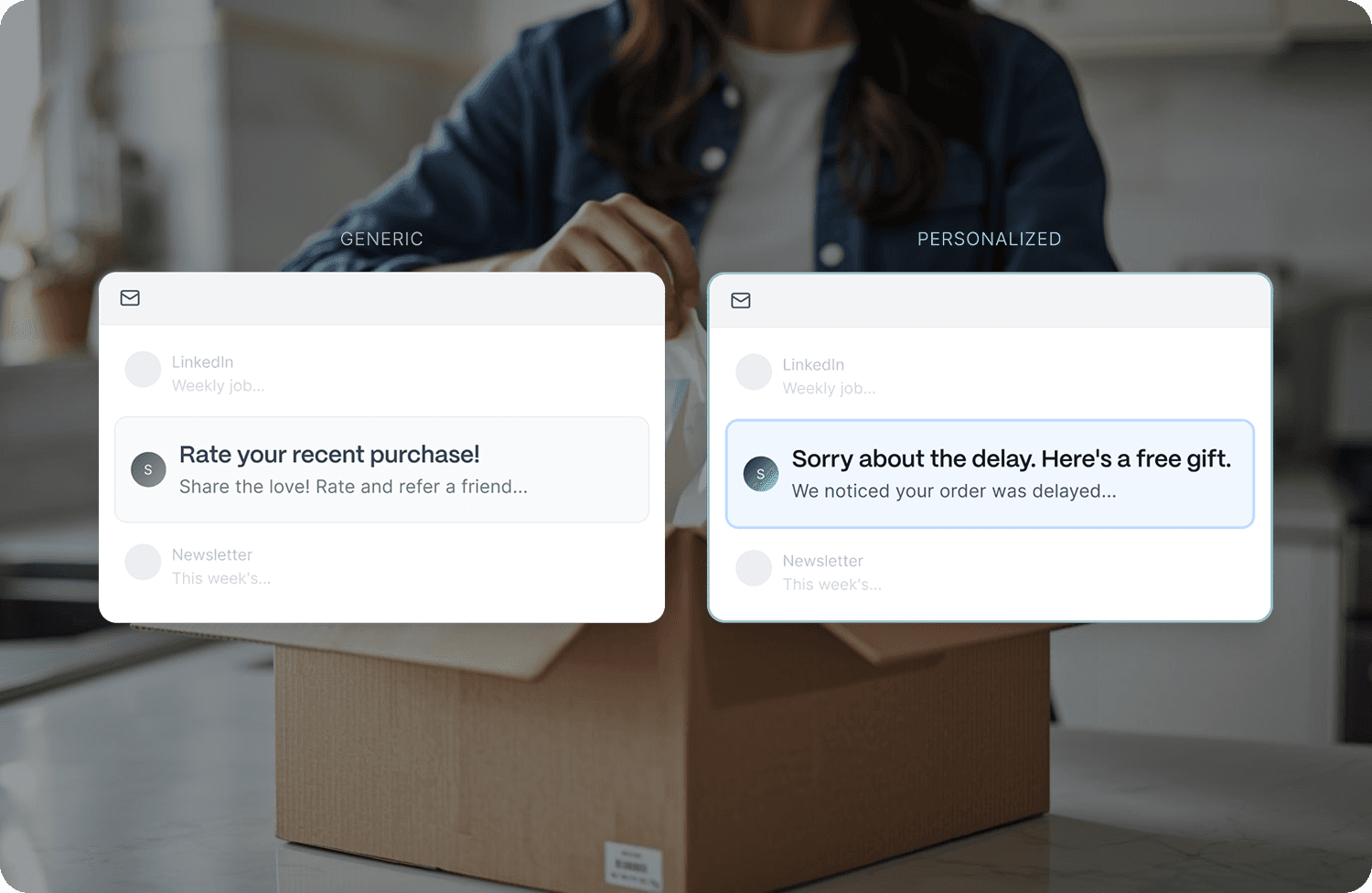
Churn prevention takes predictive insights a step further by turning information into action. Once the system identifies high-risk subscribers, it recommends specific, personalized interventions designed to prevent cancellation.
These interventions are not generic.
They are based on the predicted cause of disengagement, whether it is product dissatisfaction, a perceived lack of value, or delayed deliveries. This enables a shift from defensive retention tactics to proactive engagement strategies.
Consider a monthly coffee subscription. If a customer gives a low rating to a curated bean selection, the AI can immediately trigger an email highlighting the customizability features and ability to swap options. It shows the subscriber you recognize their dissatisfaction and have already prepared a solution well before they even consider hitting cancel.
By acting on predictive insights rather than letting them sit in a spreadsheet, you can target specific audience segments with personalized offers that maximize return on retention spend.
Use Case #3: Discount Prioritization
Discounts are a direct drain on margins.
Subscription box companies carry fixed product and shipping costs that make discounting a particularly delicate decision. A meal kit box sending a 10% percent discount to the entire list would destroy margin, even though many subscribers would have renewed at full price anyway.
Discount prioritization via AI prevents that by strategically deploying targeted incentives only where they make a measurable difference. This ensures that retention offers are used only when necessary and on the customers whose retention will yield the highest Customer Lifetime Value return.
By precisely managing who receives an offer, you maximize the impact of your retention budget while avoiding unnecessary profit loss.
Use Case #4: Renewal Optimization
Renewal optimization focuses on the touch points leading up to a customer renewal.
AI gives predictive insights and identifies friction points, then it recommends a timely nudge. This ensures that renewal prompts are sent when they are most relevant to the customer, not just when a billing cycle ends.
Timing interventions based on behavior rather than fixed dates increases the likelihood that subscribers stay engaged and renew.
A practical example is a daily contact lens subscription that leverages usage and purchase patterns. Subscribers who wear lenses consistently receive a timely renewal prompt a few days before they are likely to run out, while occasional users are left undisturbed until their next probable need.
By analyzing actual product usage data, AI can determine how quickly a subscriber is consuming their items and whether a renewal is truly needed at that moment. This avoids sending premature offers that annoy customers or create friction.
Use Case #5: Personalized Engagement
Personalized engagement empowers subscription box companies to create meaningful relationships at scale. For curated subscription box services, this is the difference between a high churn rate and a thriving community.
Customers sign up for a specific experience and they will leave if that experience begins to feel generic over time. AI identifies individual preferences and crafts a tailored experience that makes each interaction feel custom made for the person.
The commercial impact is dual: increased LTV through sustained loyalty and higher Average Order Value (AOV) through intelligent upsells.
If the AI knows a subscriber is consistently rating artisanal coffee in their survey responses, it could prioritize similar coffee samples in their box as a way to ensure customer satisfaction. It could also promote a one time, high margin 'Roaster's Choice' add on during the month they are most engaged for a targeted upsell.
The provides boutique level of service to thousands of people at once. Companies that rely on static customer segments will not only lack this personalized touch, they risk being out of touch completely. This will inevitably lead to sending the wrong upsell offer — or they might even send products the customer does not want, directly accelerating the cancellation.
Use Case #6: Automated Outreach
The best retention plan is useless if it moves too slowly. Manually monitoring predictive scores and executing complex, personalized campaigns is a massive burden for any team. This task becomes even more daunting when you are working across multiple tools and data silos.
If you have to download metrics from one place, track engagement in a CRM, and deploy offers using a third tool, you are guaranteed to lose revenue due to administrative delay. You simply cannot act fast enough to make a difference.
For a subscription box, this speed is critical during the value delivery phase. If a tracking number shows a delivery exception, the AI can instantly trigger an SMS apology and a loyalty credit. The customer gets a resolution before they even have a chance to get frustrated.
Tools like Churned's Co-Pilot AI connect your CRM, marketing, billing and other subscription data to process the data for insight and trigger actions back to your tech stack, without having to switch in between.
This ensures that your message is sent to subscribers at exactly the right moment.
Subscriber Retention = Revenue Growth
The transition from manual, reactive churn management to an automated, intelligent system is the hallmark of a modern subscription business.
When you eliminate administrative friction and act on behavioral signals in real time, retention stops being a defensive cost center and becomes a primary driver of growth. The question is no longer if you should adopt AI, but how quickly you can deploy it to protect your recurring revenue.

Written by
Jessica Rangel
Share:
Curious what Churned can do for your business?