Subscription products
Top 3 DTC Subscription Models — And The Churn Risks for Each
Share:
Ask three subscription brands why their last hundred cancellations happened and you'll get three different answers.
Even if their churn rate is identical.
That’s because not every DTC subscription brand runs the same business. But most retention advice treats subscription churn like one problem with one fix.
The model a brand runs determines where subscribers actually fall off. Treating a subscription fatigue problem like a replenishment problem is often why the churn fix doesn't work.
Here's how the three core subscription models work and the unique churn risks each face.
3 Primary DTC Subscription Models
Replenishment
The replenishment model ships products customers use up and need again.
This model is typically found in consumable products like personal care (razors, deodorant, toothbrushes) or household supplies (coffee, toilet paper, pet food).
The subscription exists to remove the friction of reordering something you'd buy anyway.
Examples: Dollar Shave Club, The Honest Company, and Native
Curation
The curation model delivers a personalized selection of products picked for the subscriber.
This model is typically found in lifestyle products where the offering changes frequently like clothing, beauty, or niche hobbies.
This subscription model exists to sell discovery: the promise that someone, or something, understands your taste better than you'd find on your own.
Examples: Stitch Fix, Birchbox, and Barkbox
Access
The access model sells belonging, not necessarily the products themself.
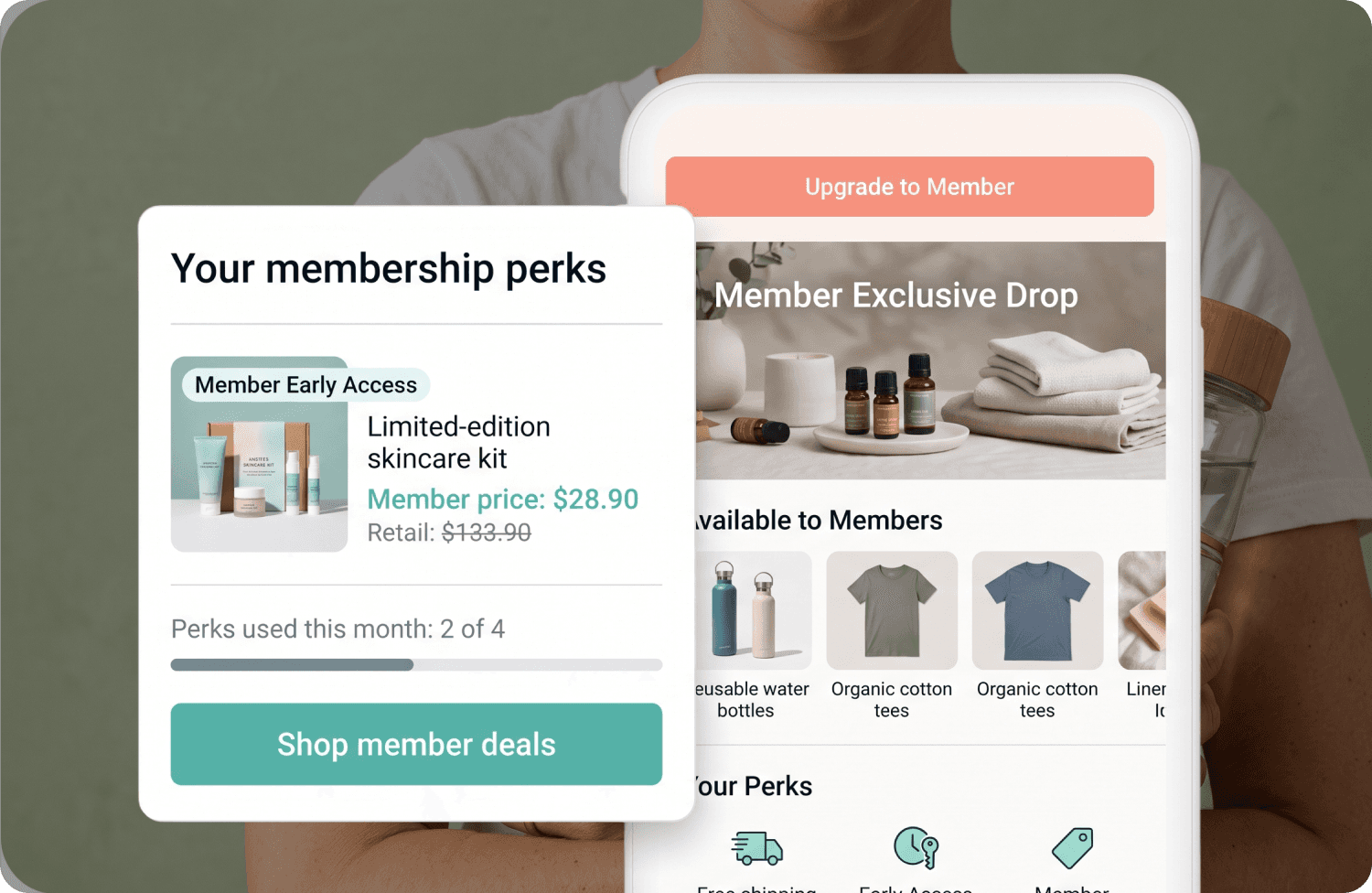
Subscribers pay a recurring fee for member pricing, exclusive drops, or perks they can't get otherwise. This is typically found in membership and marketplace subscriptions where subscribers pay for pricing, perks, or exclusivity, like retail memberships, buying clubs, or box-plus-perks hybrids.
In other words, the subscription is the membership — not the box.
Examples: Amazon Prime, Thrive Market, and FabFitFun

Where Each Model Actually Loses Subscribers
Replenishment: Ignoring customer behavior
Churn Risk: Delivery doesn't match how much the subscriber is actually using. |
Retention Solution: Give subscribers control over delivery frequency, including the ability to skip or pause. |
Every subscriber consumes product at a different pace. One goes through a bottle in six weeks, another stretches it to ten. Shipping both of them on the same fixed schedule guarantees one of them ends up either running out too early or sitting on a backlog.
Here’s what this solution looks like in practice:
Make frequency adjustment, skip, and pause easy to find and use, not buried three menus deep in account settings.
Suggest a new frequency proactively when usage data shows a subscriber is consistently running early or late.
Send a quick check-in before shipping if signals suggest the last order hasn't been used up yet.
Real-life Use Case A men's grooming brand added the ability for subscribers to adjust their shipping frequency directly from their account, instead of only offering skip or cancel. Subscribers who felt out of sync with their delivery schedule could slow it down or speed it up on their own. Subscribers who used the frequency adjuster were significantly less likely to cancel than those who didn't have that option. |
Curation: Declining engagement goes unnoticed
Churn Risk: The subscriber gets bored with what they're receiving. |
Retention Solution: Flag disengagement before cancellation and adjust engagement outreach so it doesn't go stale. |
The biggest churn risk in a curation model is what we call “the drift”. This is the stretch of time between "this doesn't feel cool anymore" and the moment a subscriber actually cancels.
It’s a slow burn process. Nobody cancels the first time a box feels generic. They open it a little less enthusiastically, then a little less often, then not at all.
By the time the cancellation shows up in your dashboard, the drift has been happening for weeks, and a save-play email at that point is already too late.
Here's what can be done instead:
Route new subscribers into different welcome journeys based on how they signed up and what they said they wanted, instead of one generic onboarding flow.
Trigger a re-personalization touchpoint the moment open rates or box ratings start declining, before the subscriber has consciously decided to leave.
Use AI to catch signals and automatically update customer profiles to reflect changing behavior.
Real-life Use Case A styling subscription found that subscribers who rated their first two boxes but stopped rating boxes after that had a far higher cancellation rate the following month, even though nothing else in their account looked different. Catching that drop before the cancellation gave the brand more time to personalize instead of scrambling to save the account after the fact. |
Access: Outreach runs on a calendar, not on value
Churn Risk: The subscriber stops feeling like the membership is worth the cost. |
Retention Solution: Know when to reach out, and when to stay quiet, based on the subscriber's actual value signals instead of a fixed schedule. |
Access subscribers don't get a product that reminds them why they're paying. The only regular touchpoint most brands offer is a renewal notice or a generic monthly email, sent to everyone on the same calendar regardless of whether that subscriber is getting value or not.
The fix is using actual engagement signals to decide when outreach matters, not defaulting to a blanket schedule.
Here's what this solution looks like in practice:
Track how often subscribers are using their perks, and flag drop-offs before renewal instead of at it.
Reach out with a specific nudge when usage drops, rather than sending the same generic message to the entire base.
Deliberately stay quiet with highly engaged subscribers instead of messaging them just because the calendar says to.
Real-life Use Case A membership brand started scoring subscribers on how much of their membership value they were actually using each month. Subscribers below a usage threshold got a targeted nudge highlighting a specific unused perk. Everyone else got left alone. Cancellations dropped among the flagged group, without adding a single extra email to subscribers who were already engaged. |
Churn Isn't One Number
Ask most DTC brands their churn rate and you get a single figure. That number is hiding three different stories: a replenishment subscriber whose delivery doesn't match their consumption, a curation subscriber who's gotten bored, an access subscriber who's stopped feeling like the membership is worth it.
Generic retention playbooks fail because they're built for an average subscriber who doesn't exist. We built Churned around this exact idea: the right intervention depends entirely on why someone is actually leaving, not a blanket discount sent to everyone who looks at risk.
Want more? Download our 2026 DTC Subscription Benchmark Report.

Written by
Jessica Rangel
Share:
Curious what Churned can do for your business?