Energy
Utility Churn Prevention: Why a Score Without a Next Best Action Isn't Enough
Share:
Utility and telco companies aren't losing subscribers because they lack data. Most have years of billing history, usage patterns, contract data, and engagement signals sitting in their CRM and billing systems.
The data isn't the problem. What happens between the data and the decision is.
Existing Retention Workflows Don't Work in Commoditized Markets
A retention or CRM team wants to run a campaign. They submit a request to the data team. The data team exports a churn list, usually based on a model that was last refreshed a few months ago. The list lands in the CRM. Someone decides on an offer, typically a blanket discount, and the campaign goes out to everyone on it.
By the time that process completes, some of those subscribers have already switched to a competitor offering €5 less per month. Others were never at risk. And a portion got a discount they didn't need to stay, cutting margin for no reason.
For energy and telco providers operating in commoditized markets, this lag isn't a minor inconvenience. It's a direct threat to Customer Lifetime Value.
Read more: Top 27 Challenges Facing the Telecom Industry for 2025 and Beyond
Churn Scores Tell You Who’s Leaving, Not What to Do Next
Most retention teams treat a churn score as the finish line. It isn't. A score tells you a subscriber is likely to leave. It doesn't tell you why, and it doesn't tell you what to do about it.
A subscriber who's price-sensitive needs a different response than one who's had three service issues in the last 60 days. A customer approaching the end of a 24-month fixed contract needs a different intervention than someone who just switched from a fixed to a variable rate.
Sending the same offer to all of them isn't retention, it's a blanket discount with a churn list attached.
For multi-service providers running Quad-Play bundles, the challenge is even more acute. Identifying which service line is the actual churn trigger requires more than a static model. Basic BI tools simply weren't built for that.
Read more: How Mega Energy Reduced Churn by 22.5% with Predictive & Prescriptive AI
How Predictive Retention Turns Insights Into Actions
What actually works is an AI model that's both predictive and prescriptive.
It doesn't just surface risk, but identifies the drivers behind it and recommends a specific Next Best Action for each subscriber profile — whether that's a proactive call, a targeted retention offer, or an upsell to a bundle that better fits their usage.
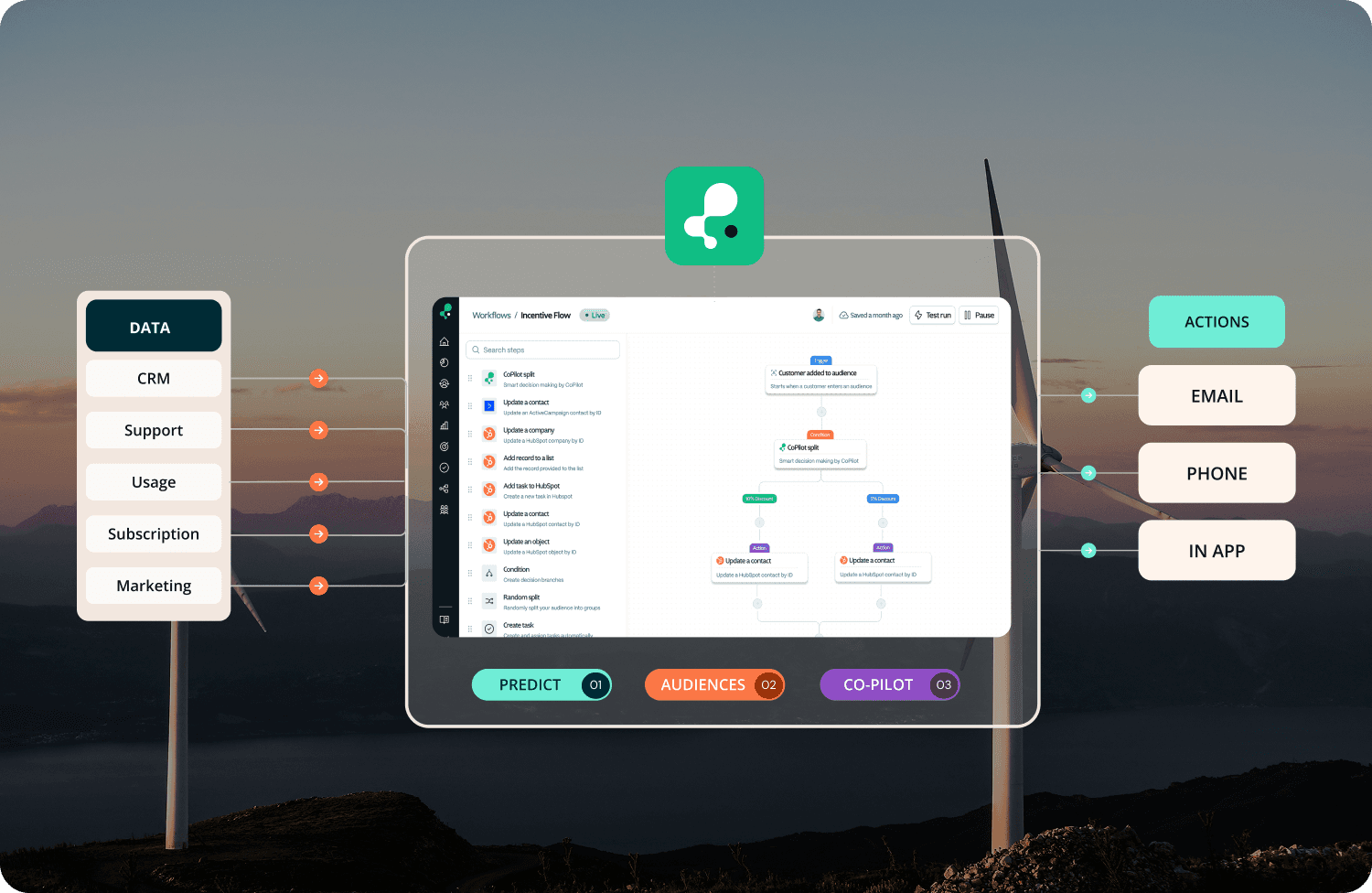
This is what Co-Pilot, Churned's proprietary AI engine, is built to do.
It integrates directly with CRM, billing, and usage data, including legacy systems like SAP, so it works with the infrastructure utility providers already have. It continuously tests actions across different subscriber segments, learns what works for each profile, and automatically applies the right intervention in real time, not via a monthly export.
Discounts go only to subscribers who genuinely need them to stay. Customers approaching a contract cliff get a renewal flow before they start comparing competitors. Retention teams spend less time managing lists and more time on strategy.
Read more: A Blueprint For CRM Integration In The Energy Sector
The AI Retention Model Built for Utility Providers
If your team is still working off static exports, running the same offer to every at-risk subscriber, and measuring results weeks after a campaign closes, the model isn't your problem. The gap between prediction and action is.
In markets where switching rates keep climbing and margin pressure isn't letting up, every contract cycle that gap costs more. That's the part worth fixing.
See how it works: AI Churn Reduction for Energy Providers

Written by
Jessica Rangel
Share:
Curious what Churned can do for your business?