Churn management
Telco Subscriber Churn: Can Your EBITDA Survive Your Discounts?
Share:
ING's analysts recently forecast 2% revenue growth for European telecoms this year.
Most people in the industry will read that number and nod. It sounds reasonable. Stable, even.
But 2% growth in a commoditised market isn't calm water. It's a very thin margin for error.
Looking at what's behind that 2%, and more importantly what's eating into it, one thing becomes clear: the operators who do well in 2026 won't be the ones who grew fastest but instead will be ones who lost the fewest customers.
Why a low-growth market changes everything
When the market is expanding fast, you can absorb churn. You replace lost subscribers with new ones, the numbers balance out, and nobody asks too many questions.
That model doesn't work at 2%.
At 2% growth, every customer you lose is a customer you have to work hard to replace. And replacing lost customers doesn’t come cheap. Acquisition costs across the sector are already elevated, and they're not coming down.
Switching is easy, and the customer you won today could be with a competitor in 6 months.
Customer acquisition isn't a one-off cost anymore, it's become a recurring one.
On top of that, providers are handing out welcome discounts just to get customers through the door, so you're paying to win them and paying again to keep them, without ever addressing why they were shopping around in the first place.
The leadership teams who understand this are shifting their thinking. They're not asking "how do we acquire more?"....they're asking "how do we stop losing the customers we already have?".
The new entrant problem isn't going away
The competitive landscape in European telecoms isn't getting easier, and most of the new competition is playing the same card: a lower price.
You can't match every price cut indefinitely. You also can't rely on regulation to slow new entrants down, because in many European markets, the regulatory framework is actively designed to foster competition.
In non-LinkedIn words — you’re against players who have nothing to lose and the marketing strategy of “we're cheaper”.
Part of the shift is that comparison platforms have collapsed the switching process entirely.
Customers can compare every provider in the market and move to a new one in minutes. You can spend heavily to win a customer and find them back on a comparison site 6 months later.
The only sustainable counter to that is knowing your customer well enough to act before they start comparing prices. If someone is at risk of churning to a €5 cheaper competitor, the window to intervene is weeks before they call to cancel, not the moment they're already on the phone.
New competition examples in the EUBelgium 🇧🇪: Digi launched in December 2024 as the country's fourth mobile operator, offering plans at €5 a month. Within months, incumbents were raising data allowances without raising prices just to respond. Spain 🇪🇸: When the EU approved the MasOrange merger, it required Digi to be handed spectrum as a condition of approval, essentially mandating new competition by regulatory design. |
The discount trap is quietly destroying margins
Here's the part that we (C-Suite, Head of Marketing, Revenue Leads) might need to sit with: a lot of telco retention teams are working hard, running campaigns, offering discounts, hitting their saved-customer targets.
But some of this is still destroying margins.
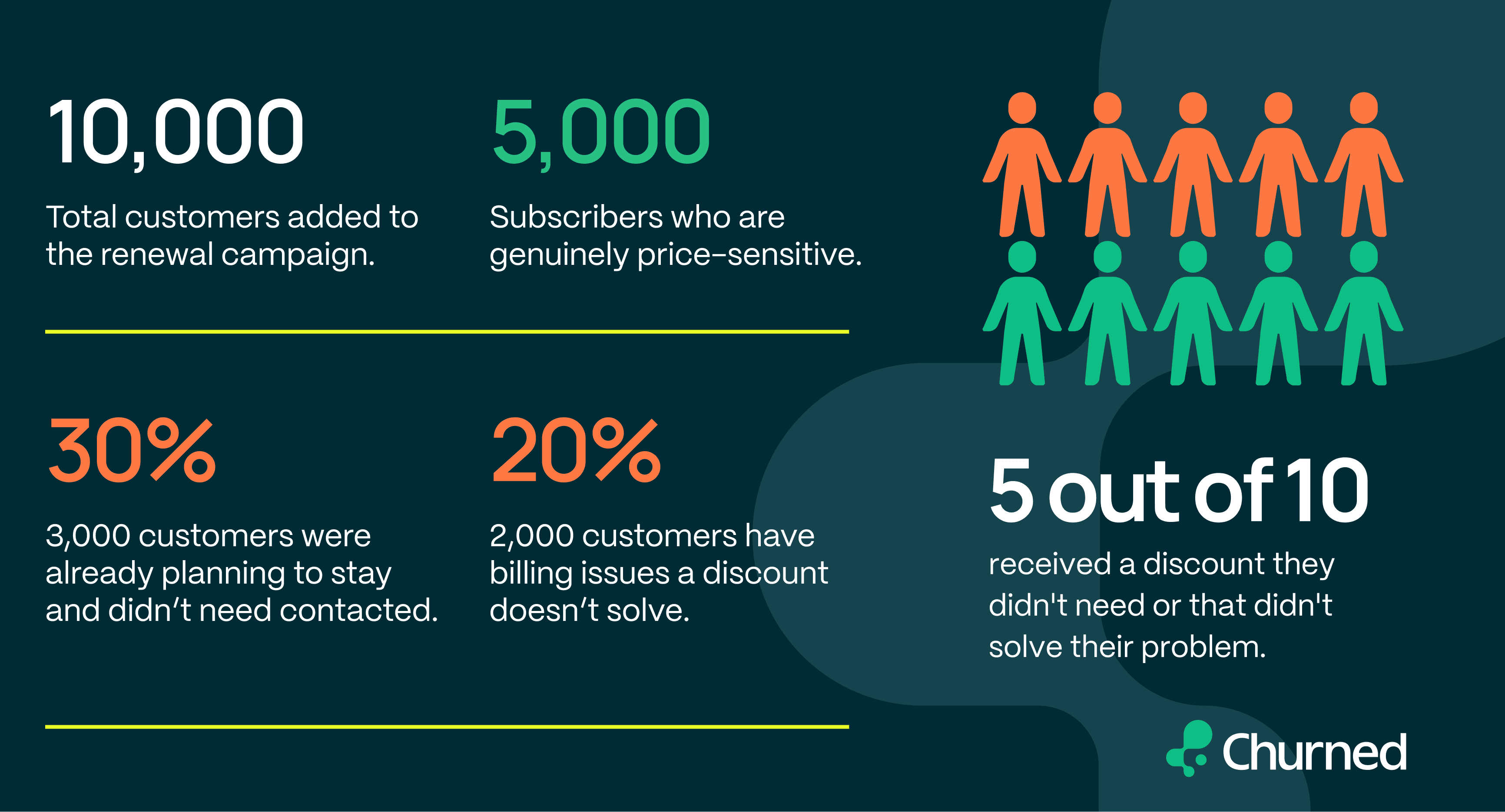
The reason is straightforward though. You (alongside many others in many other industries) just trained them to expect a discount at renewal.
When you don't know which customers are genuinely at risk, and for what reason, you end up offering discounts to people who were going to stay anyway.
The customers who left for a service issue could have been offered an alternative.
The ones who got a cheaper offer elsewhere could have been matched.
The ones going through a life event could have been given a flexible contract.
They all got a discount instead.
The fix isn't to stop retaining. It's to retain smarter. That means knowing whether a specific customer needs a discount, a call, an upsell, or nothing at all. It also means being able to make that decision at an individual level, not a broad-demographic level.
Where the real opportunity is
ING's analysts expect EBITDA to grow faster than revenue this year.
That's a cost rationalisation story, and it's a real one.
But EBITDA is also where a poorly run retention strategy will quietly do its damage. Every unnecessary discount, every win-back campaign on a customer who left months ago, every saved-customer metric that masks margin erosion, it all lands on the same line.
If your retention strategy is giving away margin to customers who don't need it, that EBITDA story starts to fall apart. If your win-back campaigns are targeting former customers reactively, months after they left, you're spending acquisition budget on a problem that should have been caught earlier.
The operators who will look good at the end of 2026 are the ones treating retention as a precision exercise, not a volume play. They know who's at risk before the risk becomes a decision. They know what offer moves the needle for that specific customer. And they're not burning margin on the ones who were never going to leave.
The bottom line
2% growth is the market giving you a clear signal. There isn't enough new revenue coming in to paper over churn. The customers you have right now are more valuable than they've ever been, and the cost of losing them, and then replacing them, is higher than most retention budgets account for.
This year, the growth story and the retention story are the same story.

Written by
Maarten Doornenbal
Share:
Curious what Churned can do for your business?